Vertical AI: How Sector-Specific Models are Reshaping Industry
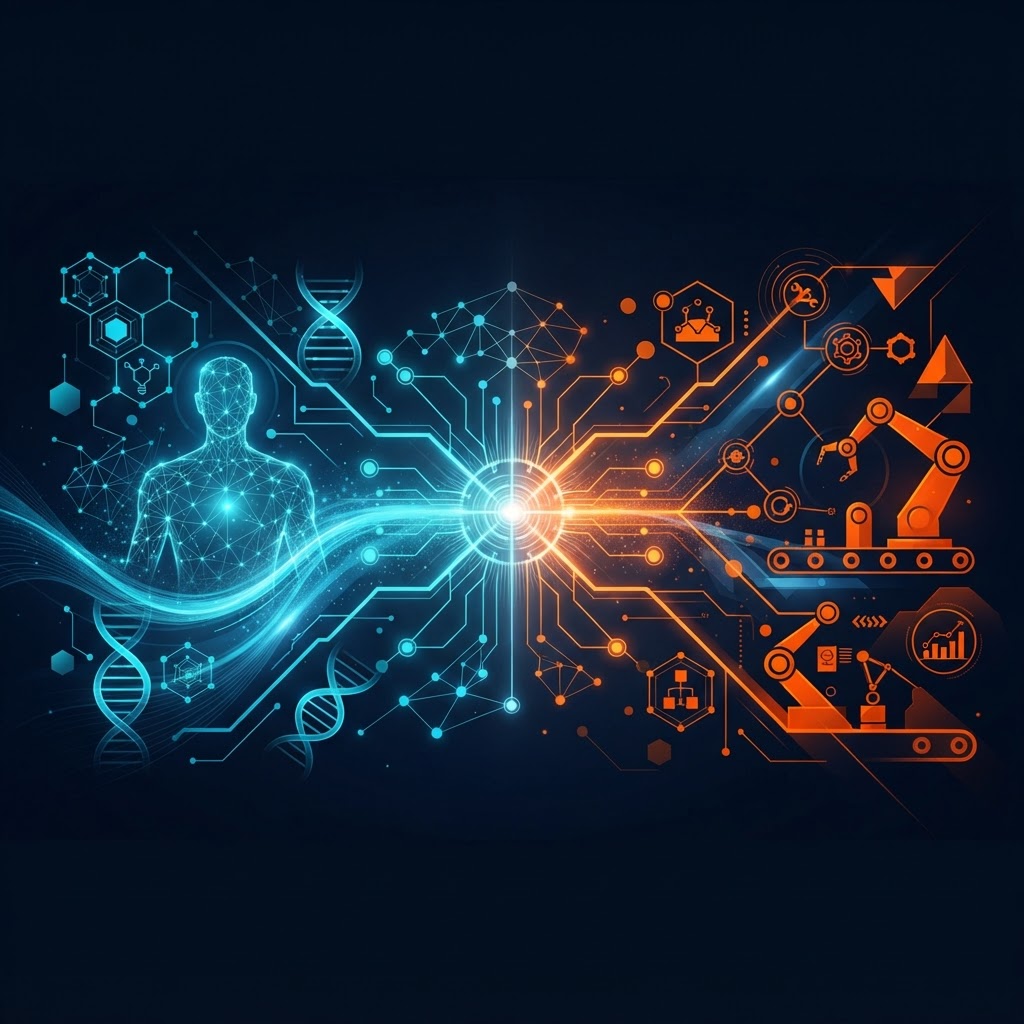
Tech leaders like Microsoft and Siemens have pivoted from general AI to specialized 'Vertical AI' for healthcare and manufacturing. This development marks a new era where multimodal models solve real-world industrial challenges like diagnostic accuracy and the technical skills gap.
CodeDexters Academy AI
The Era of Specialization: Why 'Vertical AI' is the New Frontier
For the past two years, the global conversation around Artificial Intelligence (AI) has been dominated by general-purpose Large Language Models (LLMs). While tools like ChatGPT showed us what was possible, the business world was left asking: "How does this solve my specific industry problems?"
In October 2024, the tech industry provided a definitive answer. A series of major announcements from Microsoft, NVIDIA, and Siemens signaled a pivot away from generic chatbots and toward "Vertical AI"—specialized, foundation-level models built specifically for sectors like Healthcare, Manufacturing, and Energy. At CodeDexters AI Professional Academy, we are tracking these developments closely, as they represent the most significant shift in AI implementation since the launch of GPT-4.
Healthcare: Multimodal Models and Clinical Breakthroughs
On October 10, 2024, Microsoft unveiled a groundbreaking suite of healthcare-specific AI models in Azure AI Studio. These are not just upgraded chatbots; they are multimodal foundation models designed to analyze complex medical data that general models often struggle with.
One of the most noteworthy releases is the collection of medical imaging models developed in collaboration with partners like Providence and Paige.ai. These models, including Prov-GigaPath, can analyze pathology slides and genomic data alongside clinical records. By integrating these disparate data types, the AI can assist radiologists and oncologists in detecting subtle patterns in cancer research and diagnostics that might be missed by the human eye alone.
Furthermore, the introduction of the healthcare agent service in Copilot Studio marks a shift toward operational efficiency. These AI agents are being deployed to handle appointment scheduling, patient triaging, and clinical trial matching. By automating these high-friction administrative tasks, AI is directly addressing the clinical burnout crisis that has plagued the healthcare industry for decades.
Manufacturing: Scaling the Industrial Copilot
While healthcare is being transformed by diagnostic AI, the manufacturing sector is witnessing a revolution in engineering and automation. On October 24, 2024, Siemens and Microsoft announced that their Siemens Industrial Copilot has moved from a successful pilot phase to a full-scale global rollout.
With over 100 customers already utilizing the tool—including giants like Schaeffler and thyssenkrupp Automation Engineering—the Copilot is proving to be a game-changer for industrial productivity. The tool allows engineering teams to generate complex automation code for Programmable Logic Controllers (PLCs) using natural language. For a sector facing a massive shortage of skilled technical labor, this is revolutionary. A maintenance worker can now ask the Copilot to debug a machine's code or generate a visualization for a new production line, reducing development times from weeks to days.
Energy: Predictive Maintenance and Grid Stability
In the Energy sector, the development of 'Digital Twins' and AI-driven predictive maintenance has reached a new level of maturity in late 2024. Projects like the WindTwin initiative, which received significant funding recently, are using AI to create exact digital replicas of wind turbines.
These models use real-time IoT sensor data to predict equipment failure before it happens. According to recent industry reports, AI-enabled predictive maintenance has the potential to decrease maintenance expenses by up to 30% and boost equipment availability by 20%. As the world transitions to renewable energy, these AI systems are becoming the 'nervous system' of the smart grid, ensuring stability by predicting demand surges and optimizing the flow of electricity from volatile sources like wind and solar.
The CodeDexters Perspective: Preparing for the Vertical Shift
The move toward Vertical AI means that the demand for 'general' AI skills is rapidly evolving into a need for 'specialized' AI expertise. It is no longer enough for a professional to know how to write a prompt; they must understand how to integrate AI into their specific industry workflow—whether that is medical imaging, industrial automation, or energy grid management.
At CodeDexters AI Professional Academy, our curriculum is designed to reflect this shift. We believe that the future of work belongs to the 'AI-Augmented Professional' who can bridge the gap between their domain expertise and these powerful new vertical tools.
Conclusion
The developments of late 2024 have proven that the next wave of AI value will be found in the details. By moving away from generic solutions and toward industry-specific, multimodal models, companies are finally unlocking the true ROI of artificial intelligence. For professionals, the message is clear: the time to specialize in industry-specific AI is now.
Key Trends to Watch:
- Multimodal Integration: The ability of AI to 'see' medical images and 'read' sensor data simultaneously.
- Agentic Workflows: AI agents that don't just answer questions but perform specific industry tasks like clinical scheduling.
- Natural Language Engineering: The democratization of complex coding in manufacturing through AI copilots.
Found this article helpful? Share it with your network:
Related Articles
Explore Your Certification Pathway
Book a consultation with a certification advisor to confirm the right pathway for your role, goals and Early-Bird eligibility.