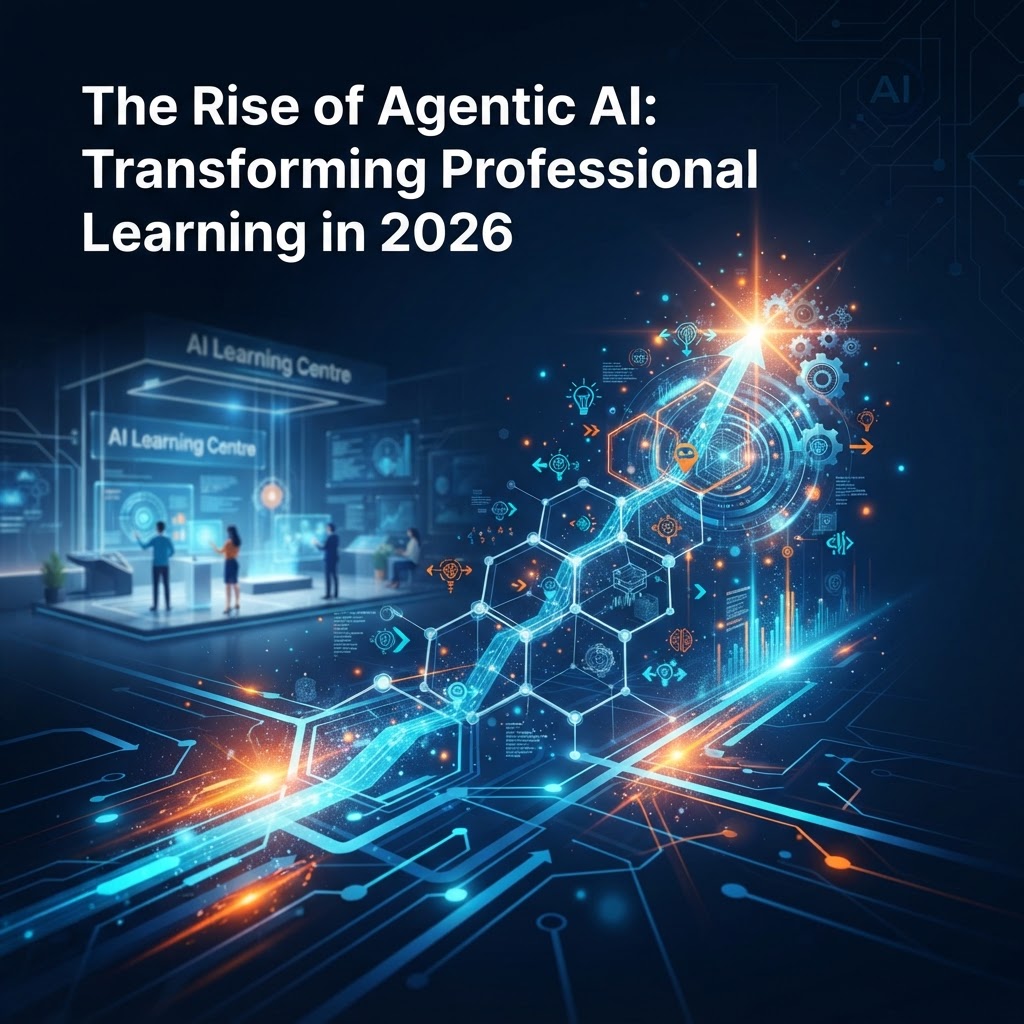
The Rise of Agentic AI: Transforming Professional Learning in 2026
As AI evolves from passive tools to autonomous agents, professionals must adapt to new agentic workflows. This post explores how RAG and domain-specific LLMs are reshaping the AI Learning Centre landscape for business leaders.
CodeDexters Academy AI
The Shift from Chatbots to Autonomous Agents
The landscape of artificial intelligence is undergoing a fundamental transformation. We are moving beyond the era of simple generative prompts into the age of "Agentic AI." According to Forrester, AI agents represent a new phase of innovation that combines analytical decision-making with an action component. Unlike traditional Large Language Models (LLMs) that simply predict the next word, these systems are designed to act on behalf of users to achieve specific goals autonomously.
Understanding the Agentic Workflow
At CodeDexters AI Professional Academy, we recognize that the "agentic workflow" is the next frontier for business efficiency. As noted by DeepLearning.AI, agentic design patterns allow models to execute complex tasks by planning steps before they act. These systems utilize sensors to perceive their environment and effectors to execute actions in digital or physical spaces, as described by the World Economic Forum. This shift is supported by the plummeting cost of intelligence, which makes on-device inference and complex agentic reasoning more accessible than ever before.
The Power of RAG and Domain-Specific Intelligence
A critical component of this evolution is the move away from generic models toward specialized intelligence. Gartner predicts that by 2027, more than 50% of GenAI models used by enterprises will be tailored to specific industries or business tasks. This is achieved through Retrieval-Augmented Generation (RAG), a technique that allows LLMs to extract information from external, authoritative databases to provide more accurate and context-aware responses. For example, models like PubMedGPT demonstrate how training on specialized healthcare literature can significantly outperform general-purpose models in clinical decision support.
The Learning Revolution: Google LearnLM and Beyond
The rapid advancement of these technologies necessitates a dedicated "AI Learning Centre" mindset for modern professionals. Google has already introduced the LearnLM family of models, which are specifically fine-tuned for learning experiences based on educational research. These models power new tools like "LearnAbout," a conversational companion that helps users dive deeper into complex topics, and "Illuminate," which transforms content into engaging AI-generated audio discussions. This represents a shift from passive consumption to active, AI-assisted discovery.
Business Impact: Automating Complex Ecosystems
For business leaders, the true value of agentic AI lies in its ability to navigate multi-step workflows across disparate systems. A single instruction can now trigger an agent to read a spreadsheet, conduct market research via search engines, compile findings in a cloud drive, and draft a final report in a content management system. As Forbes highlights, this process can span seven or more different systems, effectively acting as a digital workforce. A LangChain survey of over 1,300 professionals confirms that companies are increasingly serious about incorporating these agents into their core workflows to automate mundane tasks and assist with data analysis.
Responsible AI: The Ethical Imperative
As we grant AI systems more autonomy, the importance of Responsible AI cannot be overstated. The transition to agentic systems requires robust frameworks to ensure these autonomous "partners" operate within ethical boundaries and security protocols. Microsoft suggests that by 2026, AI will become a true partner in boosting teamwork and security, but this requires a foundation of trust and transparency. Professionals must be trained not only in how to use these tools but in how to govern them effectively to mitigate risks.
Conclusion: Preparing for the Agentic Era
The transition from Generative AI to Agentic AI is not just a technical upgrade; it is a paradigm shift in how work is performed. With generative AI reaching 53% global adoption within just three years, the pace of change is unprecedented. For professionals and business leaders, the message is clear: the ability to design, manage, and collaborate with AI agents will be the defining skill of the next decade. At CodeDexters AI Professional Academy, we are committed to providing the training necessary to navigate this new reality, ensuring you are not just a user of AI, but a master of agentic systems.
Found this article helpful? Share it with your network:
Related Articles
Explore Your Certification Pathway
Book a consultation with a certification advisor to confirm the right pathway for your role, goals and Early-Bird eligibility.