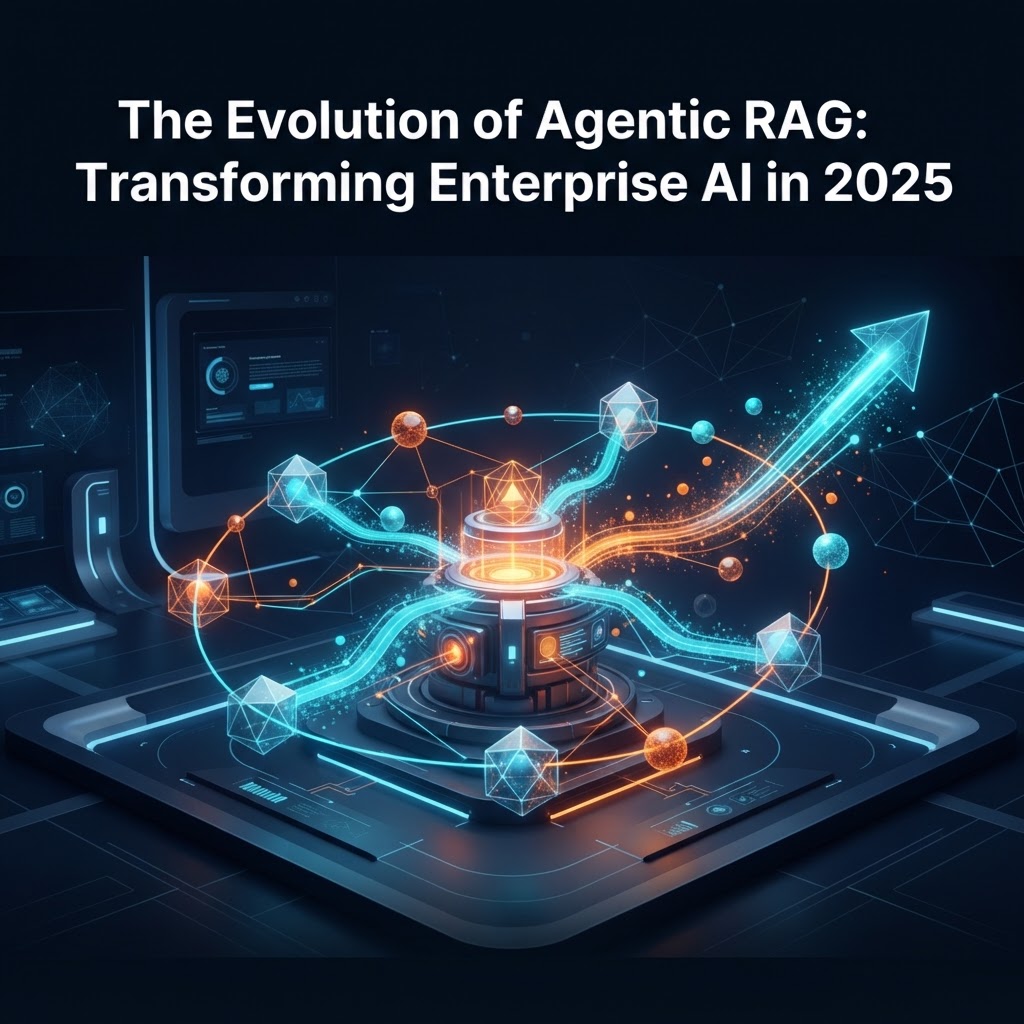
The Evolution of Agentic RAG: Transforming Enterprise AI in 2025
Discover how the shift from static retrieval to Agentic RAG is revolutionizing enterprise AI by enabling autonomous reasoning and complex problem-solving. Learn why this evolution is critical for businesses looking to leverage proprietary data effectively.
CodeDexters Academy AI
The Rise of Agentic RAG: Beyond Static Retrieval
As we navigate the rapidly evolving landscape of artificial intelligence, the focus for business leaders and technical professionals has shifted from simple Large Language Model (LLM) implementation to sophisticated, autonomous systems. The most significant development in this space is the transition from traditional Retrieval-Augmented Generation (RAG) to Agentic RAG Source: LAI #87.
What is Agentic RAG?
Traditional RAG has long been the gold standard for grounding LLMs in proprietary data, effectively reducing hallucinations by providing factual context Source: AlphaXiv. However, static retrieval often struggles with multi-step reasoning or complex queries that require deep analysis. Agentic RAG bridges this gap by combining the retrieval capabilities of RAG with the autonomous reasoning power of AI agents Source: ArXiv.
Instead of simply fetching a document, an Agentic RAG system can:
- Iteratively refine queries: The agent evaluates the initial search results and decides if further information is needed.
- Perform multi-round reasoning: It breaks down complex business problems into smaller, manageable tasks Source: ArXiv.
- Integrate diverse data sources: By utilizing knowledge graphs and structured databases, these agents provide more accurate, context-aware insights Source: ArXiv.
Why This Matters for Enterprise AI
For organizations, the goal is no longer just to have a chatbot; it is to deploy AI that can act autonomously to drive decision-making Source: Oracle. Agentic RAG allows companies to:
- Improve Accuracy: By synergizing retrieval with reasoning, models can handle nuanced, domain-specific tasks that standard LLMs might fail to interpret correctly Source: ArXiv.
- Enhance Scalability: With the emergence of shared knowledge bases, such as Agent KB, multi-agent systems can learn from a collective pool of experiences, facilitating cross-domain knowledge transfer Source: LAI #87.
- Reduce Operational Costs: As AI becomes more specialized and local, businesses can deploy cost-efficient models that process data securely on-premises or in private clouds Source: Forbes.
The Future of AI Learning
The AI landscape in 2025 is defined by smarter, more autonomous solutions Source: Forbes. As we move forward, the ability to integrate these advanced RAG techniques will be a key differentiator for competitive enterprises. At CodeDexters AI Professional Academy, we emphasize that understanding the interplay between LLMs, reasoning, and retrieval is essential for any professional aiming to lead in this new era.
Conclusion
Agentic RAG represents a fundamental shift in how we build intelligent systems. By moving beyond static retrieval, organizations can unlock the true potential of their proprietary data, creating AI agents that don't just answer questions, but solve complex business challenges. As these technologies continue to mature, staying informed and skilled in these methodologies will be the hallmark of the next generation of AI leaders.
Found this article helpful? Share it with your network:
Related Articles
Explore Your Certification Pathway
Book a consultation with a certification advisor to confirm the right pathway for your role, goals and Early-Bird eligibility.