The AI Governance Gap: Why Speed is Outpacing Safety in Business
Recent research reveals that while AI adoption is accelerating rapidly, governance frameworks are failing to keep pace. This article explores the critical visibility gap and provides actionable strategies for leaders to secure their AI-driven digital transformation.
CodeDexters Academy AI
The AI Governance Gap: Why Speed is Outpacing Safety in Business
In the race to achieve digital transformation, businesses are deploying artificial intelligence at an unprecedented rate. From generative AI assistants to autonomous agents, the technology is fundamentally reshaping how we work. However, a concerning trend has emerged: AI adoption is significantly outpacing the governance frameworks required to manage it safely.
The Visibility Crisis
Recent reports indicate that while organizations are eager to capture the productivity gains of AI, they are struggling to maintain control. According to a 2026 study by SAP, 66% of organizations are already piloting agentic AI—software capable of executing complex tasks without constant human oversight—yet 97% of leaders admit they are not fully prepared to govern these deployments [2].
This "visibility gap" is not just a theoretical concern. Research from Jamf highlights that nearly 82% of IT and security leaders have either experienced an AI-related incident or expect one in the near future [4]. As teams adopt third-party AI tools and integrate them into existing software, the lack of oversight creates significant blind spots regarding data privacy, compliance, and operational risk [4, 10].
Bridging the Gap: A Strategic Imperative
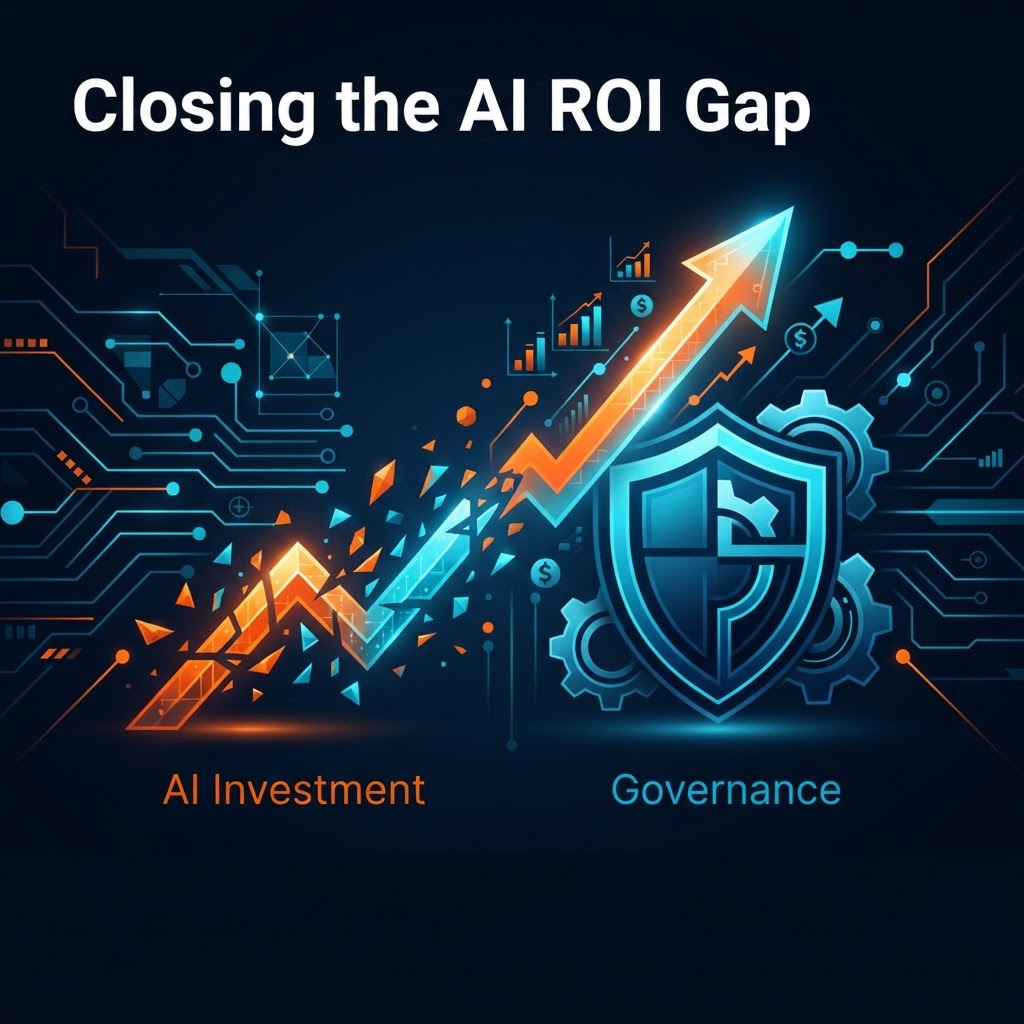
For business leaders, the challenge is no longer just about adoption; it is about sustainable, secure integration. To close the gap between AI spend and measurable business results, organizations must shift their focus toward:
- Enhanced Visibility: Implementing tools that track AI usage, token costs, and performance to ensure that investments align with actual business outcomes [8].
- Proactive Governance: Establishing clear policies for autonomous agents before they are deployed at scale to mitigate risks to workforce decisions and data integrity [2].
- Risk Management: Treating AI compliance as a core component of digital transformation rather than an afterthought [10].
Turning Strategy into ROI
While the risks are real, the potential for ROI remains the primary driver for AI investment. Early adopters are already finding success by connecting AI spending directly to tangible business outcomes [9]. By utilizing platforms that monitor AI Total Cost of Ownership (TCO) and usage, companies can ensure that their AI strategy remains both productive and profitable [8].
Conclusion
The technology is ready, but the business must be ready to manage it. As we move further into the era of agentic AI, the leaders who succeed will be those who prioritize governance as highly as they prioritize innovation. By closing the visibility gap today, organizations can harness the full power of AI while safeguarding their future.
Are you ready to lead your organization through the AI transition? Join us at CodeDexters AI Professional Academy to master the strategies needed for responsible and profitable AI adoption.
Found this article helpful? Share it with your network:
Related Articles


Explore Your Certification Pathway
Book a consultation with a certification advisor to confirm the right pathway for your role, goals and Early-Bird eligibility.