
The ROI of AI Governance: Scaling Business Value in 2026
As AI adoption shifts from experimental pilots to core enterprise infrastructure, effective governance has emerged as the primary multiplier for sustainable ROI. This article explores how business leaders can move beyond tactical automation to achieve long-term competitive advantage through strategic AI integration.
CodeDexters Academy AI
The New Era of AI-Driven Enterprise
Artificial Intelligence is no longer a peripheral innovation project; it has become the central pillar of modern digital transformation. According to Deloitte’s 2026 research, 66% of organizations are already reporting tangible productivity and efficiency gains from AI, while 53% cite improved decision-making capabilities. However, as AI becomes embedded in core business applications—often through standard SaaS subscriptions and ERP updates—the challenge for leadership has shifted from 'how to adopt' to 'how to govern and scale.'
Moving Beyond Efficiency to Transformation
Many organizations fall into the trap of using AI solely for 'efficiency plays'—automating existing, repetitive tasks. While this provides immediate relief, Deloitte’s 2025 Technology Futures report highlights that companies using AI to enable fundamentally new capabilities report 3x higher impact scores on business outcomes.
To achieve this, leaders must prioritize:
- Industry-Specific Use Cases: Purpose-built solutions consistently outperform generic AI tools, delivering up to 2.2x higher ROI Accenture, 2025.
- Strategic Integration: Rather than standalone projects, successful firms embed AI into the platforms teams use daily, such as CRM and analytics suites Enterprisetimes, 2026.
- Data Quality: With 61% of executives citing data governance as the primary barrier to scaling Gartner, 2025, investing in high-quality, representative datasets is non-negotiable Appen, 2024.
Governance as a Growth Multiplier
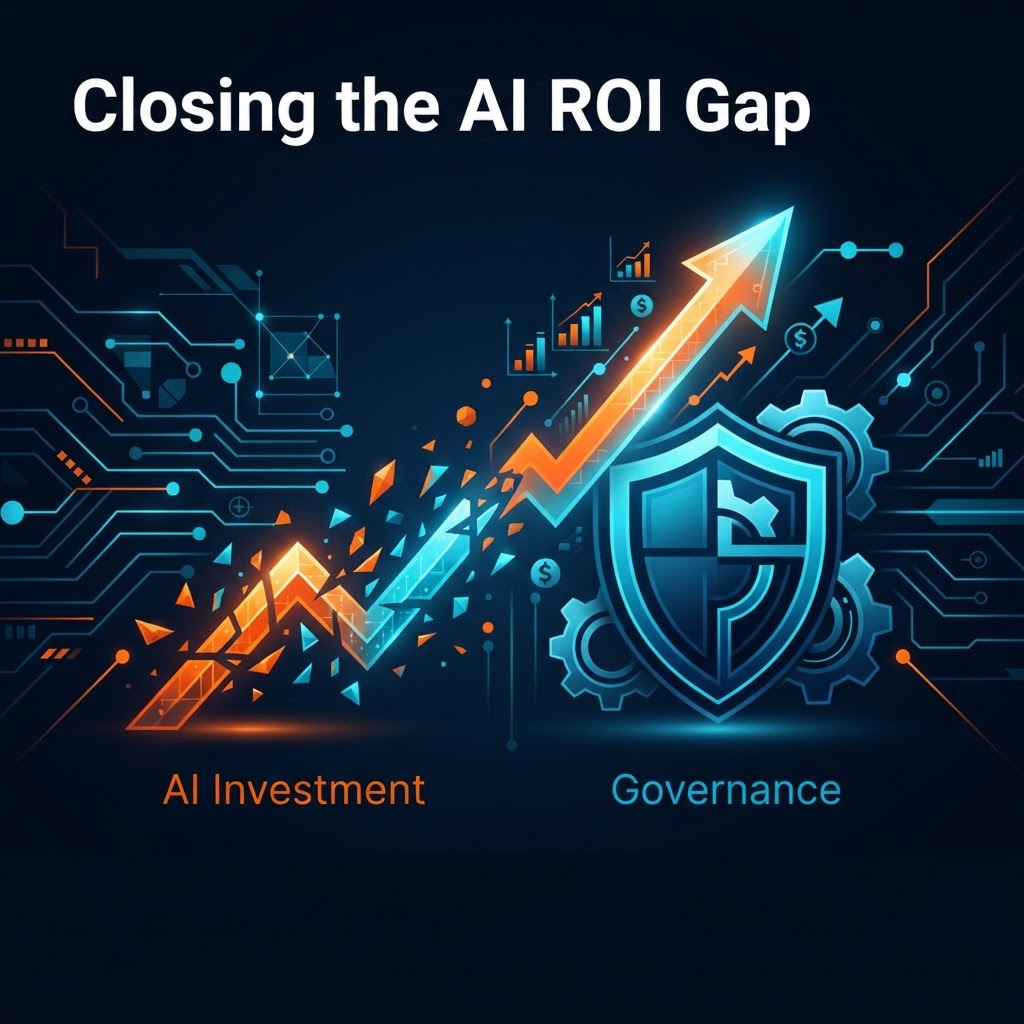
There is a common misconception that AI governance acts as a 'brake' on innovation. In reality, robust governance is the framework that makes enterprise-wide scaling possible. Deloitte notes that enterprises where senior leadership actively shapes AI governance achieve significantly higher business value than those that delegate it solely to technical teams.
Effective governance addresses the critical risks that can derail AI initiatives, such as model inaccuracy and compliance failures. With 51% of organizations reporting at least one negative consequence from AI deployment Sotatek, 2026, a structured approach—aligned with frameworks like the NIST AI RMF or the EU AI Act—is essential to protect the business and ensure long-term ROI.
Conclusion: The Path Forward
For business leaders, the mandate is clear: stop treating AI as a series of disconnected experiments. By aligning AI investments with clear business outcomes, prioritizing data integrity, and treating governance as a strategic multiplier rather than a cost center, organizations can secure a significant competitive advantage. As McKinsey research suggests, those who evolve their AI strategies now could see a 122% surge in free cash flow by 2030, while those who neglect it risk falling behind in an increasingly automated economy.
Found this article helpful? Share it with your network:
Related Articles

Explore Your Certification Pathway
Book a consultation with a certification advisor to confirm the right pathway for your role, goals and Early-Bird eligibility.