Beyond Chatbots: The Rise of Autonomous AI Agents in 2026
In 2026, the shift from passive AI assistants to autonomous agents has redefined workplace productivity. Learn how 'agentic workflows' are helping professionals reclaim an entire workday each week while transforming project management and coding.
CodeDexters Academy AI
The Era of Agentic Productivity: How AI Agents Are Reshaping the Workplace
For the last several years, professional productivity was defined by the 'prompt-and-response' loop. We asked chatbots to summarize emails or suggest code snippets, and they obliged. However, as we move through mid-2026, a fundamental shift has occurred. We have officially transitioned from the era of passive AI assistants to the age of Autonomous AI Agents.
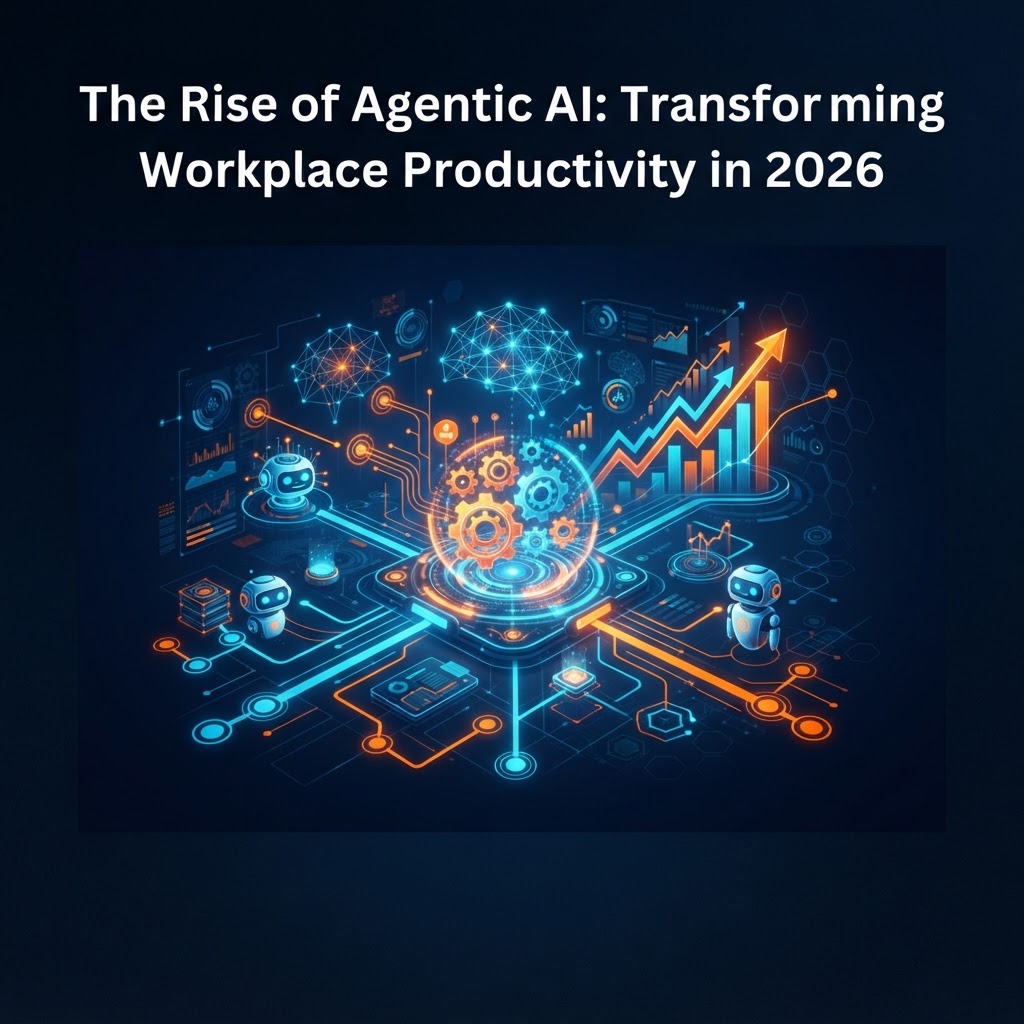
Recent industry analysis reports a rapid proliferation of these 'agentic' systems across enterprise infrastructure. Unlike their predecessors, these agents don't just answer questions; they execute multi-step workflows, manage complex projects, and甚至 operate entire segments of the software development lifecycle with minimal human intervention. For the modern professional, this isn't just an upgrade—it's a total rewrite of how work gets done.
AI Coding: From Autocomplete to Autonomous Architects
One of the most profound transformations has been in AI Coding. As of May 2026, leading AI labs like Anthropic report that over 80% of the code merged into their internal codebases is now authored by AI agents. The release of GitHub Copilot Workspace has effectively turned every developer into a 'system architect.'
Developers no longer spend their days on 'literal programming'—the act of manually typing out logic. Instead, they use natural language to define a high-level plan, and the AI agent orchestrates the creation of files, bug testing, and pull requests. This 'agentic dev environment' has shifted the primary skill set of engineers toward design, security verification, and business alignment. While code churn has increased, the ability to build and iterate on complex applications has reached a pace previously thought impossible.
AI Project Management: The Rise of the Virtual Coordinator
In the realm of AI Project Management, Microsoft’s 'Team Copilot' and the 'Work IQ' intelligence layer have redefined team collaboration. These agents now act as autonomous facilitators within Microsoft 365, managing meeting recaps, assigning action items based on real-time chat context, and tracking project milestones across entire organizations.
These agents are no longer confined to single apps; they reference data from Outlook, Teams, and specialized ERP systems to provide a unified view of progress. Market data suggests that active agents in enterprise ecosystems grew 18x over the last year. These systems are solving the 'productivity paradox' of the early 2020s by handling the administrative 'work about work' that previously consumed up to 60% of a manager's day.
The Productivity Dividend: Reclaiming the 40-Hour Week
Groundbreaking research from the London School of Economics (LSE) in early 2026 highlights the tangible impact of these developments. Professionals who have mastered agentic tools are now saving an average of one full workday every week. This 'productivity dividend' is creating a two-track labor market:
- Frontier Professionals: Advanced AI users who focus on quality control, critical thinking, and directing AI agents to handle execution. They report spending 66% more time on high-value strategic work.
- The Stalled Majority: Organizations that haven't redesigned their workflows around human-agent collaboration are seeing only marginal gains (roughly 10%), despite heavy investment in AI seats.
The gap between what individuals can do and what organizations are built to support is the new frontline of business competition. Those who treat AI as a 'thinking partner' rather than just a tool are pulling ahead at an unprecedented rate.
Conclusion: Preparing for the Agentic Future
The move toward autonomous AI agents represents a $52 billion market shift that will only accelerate as we approach 2030. For professionals and business leaders at CodeDexters AI Professional Academy, the message is clear: the most valuable skill in 2026 is no longer the ability to do the work, but the ability to orchestrate it.
As AI agents take on the heavy lifting of execution—whether in finance, HR, or software development—human agency is becoming more important than ever. To stay relevant, professionals must pivot from being task-trackers to becoming outcome-driven architects who know how to govern, secure, and leverage the autonomous power of agentic AI.
Found this article helpful? Share it with your network:
Related Articles
Explore Your Certification Pathway
Book a consultation with a certification advisor to confirm the right pathway for your role, goals and Early-Bird eligibility.